

The chronology rebuilds itself.
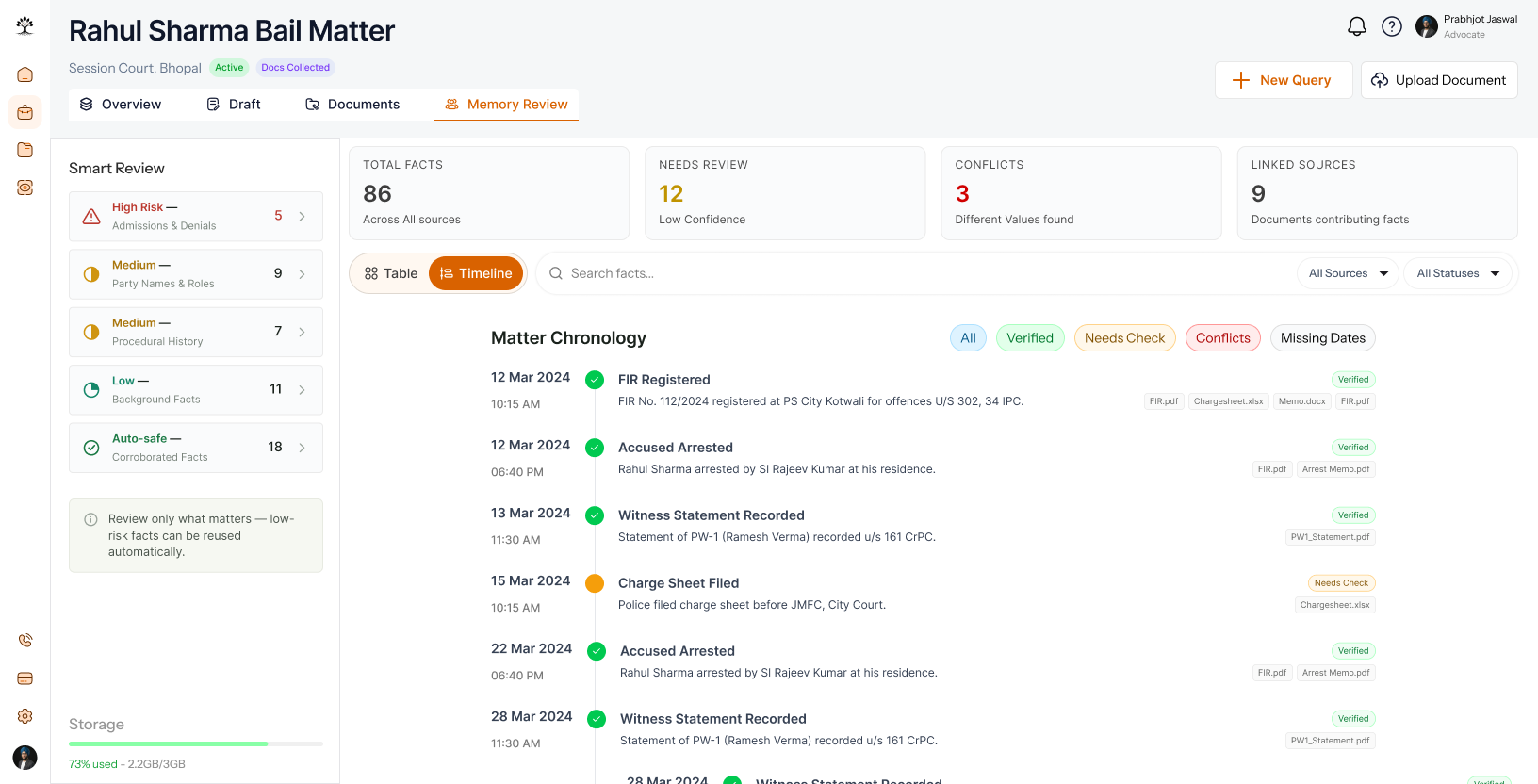
Every fact with a timestamp becomes a row on the timeline, linked to its source — built from extracted dated facts, not typed by hand.
Pillar 03 · Case chronology & hearing prep
LawVriksh rebuilds the case's timeline from its own documents — and turns it into court-ready argument notes.
Even if you created the matter two minutes ago, the right documents reveal the case's real history — in order — ready for tomorrow's hearing.
The question this answers
"How do I prepare an old matter for tomorrow's hearing?"
Open the matter, read the timeline, generate the notes.
What it means
Case chronology is the case told in order of time — every event, document and date laid out so nothing is missed. Hearing prep turns that chronology and the draft into a tight sheet of arguments you can carry into court.
A hearing tomorrow shouldn't mean reconstructing the sequence of events from a thick, disordered file at 11 PM.
The history of a matter doesn't come from how long it has existed — it comes from the documents. Link the right files and the real chronology appears, in order, each event tied to its source.
From there, hearing prep pulls the case's core arguments, key facts, and the prayer onto one court-ready sheet — grounded in the draft and the matter's verified facts.
"Even if you created the matter two minutes ago, the right documents reveal the case's real history — in order — and you can turn it into argument notes for the hearing."
The real problem
A hearing is tomorrow and you're reconstructing the sequence of events from a thick, disordered file at 11 PM.
A matter from two years ago is listed again. Nobody remembers when the FIR was filed, when the arrest happened, when the chargesheet came.
Dates buried across an FIR, a medical report, witness statements and orders — different formats, some in Hindi numerals, some relative.
Juniors hand-build argument sheets the night before, often missing a citation or a key fact.
The common thread: the timeline exists, but it's locked inside scattered documents — and rebuilding it by hand under deadline is where mistakes happen.
How it works
From linked documents to a court-ready sheet — the timeline assembles itself, and you carry it in.
Facts — including dated events — get extracted automatically the moment a document joins the matter.
The case's events appear in chronological order, each tied to its source document.
Conflicting or missing dates are surfaced so you fix them and get a reliable chronology.
From the relevant draft, produce a court-ready Argument Notes sheet — core arguments, key facts, and prayer.
Print it, save it as a PDF, or share it. The notes are A4 print-optimised.
The notes prepare the lawyer; the advocate argues the case. LawVriksh builds a reliable chronology by surfacing gaps and conflicts — never by guessing.
Behind the scenes
Each capability below is a mechanism — the reason a claim about case chronology is actually true.
Every fact with a timestamp becomes a row on the timeline, linked to its source — built from extracted dated facts, not typed by hand.
Explicit dates in any format are standardised; relative references like "the following day" are resolved; ambiguous dates are flagged with both readings shown.
A known event with no readable date becomes a "Missing Date" item; two irreconcilable dates become a contradiction shown side by side — surfaced, never guessed.
Click a timeline row and the exact source document and span opens — page-level trace for the timeline too.
The sheet pulls core arguments with draft page and citation references, a key-facts quick reference, and the prayer — court-ready, not generic talking points.
Hearing Readiness and Memory Health tell you how prepared the matter actually is — your prep status at a glance.
Before you ask
Open the matter, look at the timeline to see the case in order, then generate the Argument Notes from the relevant draft. You get core arguments, key facts and the prayer on one sheet — ready to print.
Yes. The history doesn't come from how long the matter has existed — it comes from the documents. Link the right files and the real chronology appears, in order.
Yes. Dates in any format are normalised, relative references are resolved against nearby dates, and anything ambiguous is flagged for you to confirm — so the timeline is reliable.
It's flagged as a date conflict with both sources shown side by side, so you decide which is right instead of being handed a wrong sequence.
Yes. Each argument carries a draft page reference and, where enabled, a case citation, plus the source document it rests on. The notes are A4 print-optimised — print, save as PDF, or share.
Founding members
Join India's case intelligence workspace built on your own documents. 250 Founding Member spots.